

 |
 |
 |
 |
 |
 |
 |

 |
In Vino, Veritas: Florida State University Professor discovers 1st Century Grape Seeds
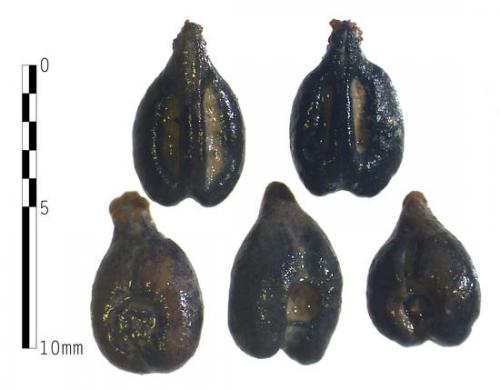
What is a Roman dinner party without a good wine? The ancient origins of wine have long been known, but as of yet, no one has discovered what types of grapes were used in Roman wine production or how Roman wine might have tasted. This past summer, Nancy Thomson de Grummond, a Florida State University professor, and her team of archaeology students discovered around 150 water-logged grape seeds at the bottom of an ancient well in Italy�s Tuscany/Cetamura de Chianti region. The seeds date from the 1st century BC. The discovery excited not only historians of the Chianti region, but also viticulturists who are interested in sequencing the DNA of wine grapes, both ancient and modern, in order to understand the development of the modern wine industry. The seeds could provide "a real breakthrough" in the understanding of the history of Chianti vineyards in the area, de Grummond said. "We don't know a lot about what grapes were grown at that time in the Chianti region," she said. "Studying the grape seeds is important to understanding the evolution of the landscape in Chianti. There's been lots of research in other vineyards but nothing in Chianti." De Grummond has worked in the Tuscany region with her students since 1983, studying the Etruscan and Roman occupants of the area. Her main area of study is art and religion. She is the author of Etruscan Myth, Sacred History and Legend and co-author of The Religion of The Etruscans, both published in 2006. From http://phys.org. |
 |
Location of Ostia Harbor Discovered
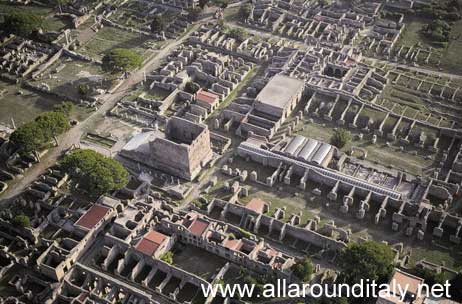
In December of 2012, three Italian-French research groups made an extraordinary discovery which was published in the journal Chroniques des M�langes de l'Ecole Fran�aise de Rome�the discovery of the location of the harbor at Ostia. The location of the town of Ostia, Rome�s main hub for maritime trading, was re-discovered in the 19th century after permission to excavate was given by the Pope (Ostia belonged to the Vatian at the time). The location of the actual harbor however, was unknown for centuries after the Tiber changed its course and flooding in the Middle Ages buried ancient quays. Research done in the 19th and 20th centuries using geomagnetic instruments pointed archaeologists northwest of the city of Ostia, yet no one had found definitive proof of the location of the harbor. The research team used stratigraphy, the branch of geology concerned with the order and relative position of strata and their relationship to the geological time scale, to find the location of the harbor using samples taken from the land northwest of Ostia. According to ancient texts, the harbor was founded by Ancus Maricus the 4th king of Rome who reigned sometime between the 4th and 2nd centuries BC. When the scientists matched the strata samples from around Ostia to that time period, they discovered that the harbor was roughly 6.5 meters deep, enough for a port. Further proof included a strata level that indicated that the sea had been present during the 4th-2nd centuries, a deep layer showing typical harbor deposits and a strata indicating alluvial accumulation that confirm Strabo�s 1st century account of the sealing of the harbor. After Ostia was abandoned, the massive city and harbor of Portus was built and settled between 42 and 64 AD during the reign of Nero. It became the main port of Rome for the duration of the Empire. From http://www.sciencedaily.com. |
|
From the Library
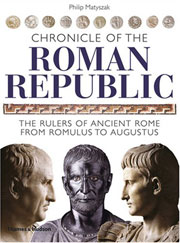
Matyszak, Phillip. (2003). Chronicle of the Roman Republic: The Rulers of Ancient Rome from Romulus to Augustus. London; Thames & Hudson. This book offers a well-rounded introduction to the history of the Roman Republic through short biographies of its leaders juxtaposed with sidebars explaining early Roman thought, law, culture and religion. The book contains color and black and white photos, maps and diagrams. The book chronicles 57 Republican leaders from the well-known to the lesser in a way that explains not only the history of Rome, but also the relationships between families and the development of the Roman political system from the Senate to the cursus honorem. Chronicle of the Roman Republic is a great introduction to the Republican era and a nice addition to any Roman library. |
|
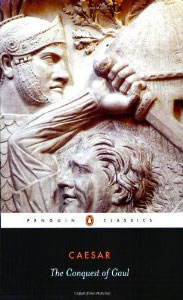
Caesar, Gaius Julius.(1982). The Conquest of Gaul. (Gardner, Jane, Trans.). Penguin Classics: London.
Caesar, Gaius Julius. (1967). The Civil Wars. (Gardner, Jane, Trans.). Penguin Classics: London. The best understanding of the Late Republican period comes from the men who lived it. Penguin Classics presents Gaius Julius Caesar�s most notable writings, The Conquest of Gaul and The Civil War in two paperback editions translated by Jane Gardner. Gardner�s translations are easy to read and give great life to the vehicles of Caesar�s campaign to win over the hearts of the Roman people. While sometimes viewed as simply propaganda, the works do give modern readers a good sense of the life and workings of the Roman army as well as a first-hand account of the annexation of Gaul to what would soon become the Roman Empire and the civil war that led to the creation of that empire. A close study will also give readers some sense of Caesar the man, or at least how he wanted us to see him. |
|
Viva La Republic!
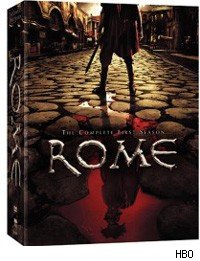
Looking for a good Roman flick set in the Late Republic? Check out these new and classic offerings. Cast and ratings information courtesy of the International Movie Database. And in other Hollywood news, Angelina Jolie is slated to play Cleopatra in a new version of the film after starring in other classics such as Alexander with Colin Firth. Oscar-winning director Ang Lee (Life of Pi) has been rumored to be interested in directing the biopic. |